A guest should never have to stop at the entrance and ask where registration is. Nor should a promising product launch lose momentum because the stage backdrop wrinkles, directional signs are missing, or sponsors are difficult to spot. Effective event signage printing services turn a venue into a clear, branded experience – helping people arrive, navigate, engage and remember why they came.
For a breakfast briefing, pop-up retail activation or multi-day exhibition, signage has a practical job to do before it becomes a photo opportunity. It directs footfall, communicates key information and gives every touchpoint the same confident brand presence. The strongest event signage is planned as part of the event journey, not ordered as a last-minute collection of banners.
Start with the guest journey
Think about the event from the visitor’s point of view. What do they see from the car park, MRT exit or venue lobby? Where do they hesitate? Which areas need to draw a crowd, and which need orderly movement? These questions shape the signage formats, sizes and messages that will genuinely support the event.
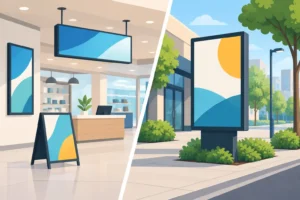
At minimum, most events need visible arrival signage, registration identifiers, directional signs and branded focal points. Larger programmes may also require room schedules, stage graphics, sponsor recognition, product information, queue management boards, safety notices and wayfinding for amenities. A well-placed sign can prevent a staff member from answering the same question fifty times.
Keep the message appropriate to the viewing distance. A large entrance banner can carry a campaign headline and logo. A directional board needs an arrow, a destination and little else. A small tabletop sign can give more detailed instructions, such as QR registration guidance or menu information. Trying to put every detail on every sign weakens readability and makes the visual environment feel crowded.
Map the signage before finalising artwork
A simple venue walk-through, whether in person or through a floor plan, avoids common production mistakes. Mark entrances, lifts, registration points, queues, halls, photo walls, speaker areas, retail counters and exits. Then assign a sign type to each location.
This also reveals practical constraints. Some venues permit freestanding display systems but restrict wall adhesives. Outdoor spaces may need weighted bases and weather-resistant materials. Hotel ballrooms often have polished surfaces where temporary signage must look premium without causing damage. Confirm venue rules early, particularly for installation timing, loading access and collection after the event.
Choosing event signage printing services by purpose
There is no single best material for every event. The right choice depends on location, duration, budget, branding and whether the item will be reused. Selecting by purpose helps you invest where people will notice and save where a simpler solution is enough.
Vinyl banners are a versatile choice for large-format branding, entrance messaging and outdoor visibility. They are durable, cost-effective and available in sizes that make an immediate impact. For events with strong winds or exposed locations, finishing details such as eyelets and reinforced edges matter as much as the printed graphic.
Foam boards and display boards give a crisp, professional finish for welcome signs, programmes, directional messaging and product visuals. They suit indoor use particularly well, where a clean, rigid surface elevates the presentation. For premium launches, mounted boards can make campaign photography, price lists and feature call-outs feel more considered than paper posters.
Roll-up banners are ideal when speed and portability are priorities. They pack down conveniently, stand independently and can be positioned at entrances, beside stages or throughout a retail activation. They work best with one clear message rather than a full brochure’s worth of text. If your brand attends regular fairs, roadshows or recruitment events, a reusable roll-up system can be a practical long-term investment.
For high-visibility brand moments, consider fabric backdrops, tension fabric displays or professionally produced photo walls. These are often the visual centrepiece of a launch, gala dinner or media event. The material, frame and installation quality are highly visible in photographs, so this is an area where accurate colour reproduction and a wrinkle-free finish are worth prioritising.
Window decals, floor stickers and counter displays can do valuable work in a compact space. They are particularly useful for pop-ups, food and beverage events and retail campaigns, where guests need to notice offers, follow a route or understand collection points quickly. However, floor graphics need suitable anti-slip finishing and should be designed to remain clear under busy foot traffic.
Balance short-term needs with reuse
A one-night dinner may only need a welcome board and stage backdrop, while an annual conference may justify modular displays that can be re-skinned with new graphics. Reusable hardware reduces future setup costs, but only if the dimensions and branding strategy are likely to remain relevant.
For campaign-specific signs, date-sensitive messaging and sponsor boards, print-for-purpose can be more efficient. The key is to avoid choosing the cheapest option without considering how it will look under event lighting, in photographs and after several hours of handling. A sign that curls, fades or falls over can undermine an otherwise polished event.
Design signage people can read at speed
Event attendees are usually walking, talking, carrying drinks or checking their phones. They will not study dense copy. Clear hierarchy is the difference between signage that works and signage that merely fills space.
Use your logo consistently, but do not let it dominate every panel. The primary message should be immediately visible, followed by essential supporting information. High contrast is especially important for directional signs and schedules. Pale text on a busy image may look stylish on screen but becomes difficult to read from a distance.
Choose type sizes based on where the audience stands. Text on a stage backdrop must be legible across the room, while tabletop materials can use smaller details. If a sign has to be read in seconds, use short phrasing, familiar symbols and arrows that clearly point in the right direction. Test artwork at actual size where possible, rather than relying only on a laptop preview.
Brand consistency matters across every printed piece. Match colours, fonts, imagery and tone from your invitation, social campaign and sales materials. This is not simply about visual polish. When guests encounter a consistent environment, the event feels deliberate and trustworthy. It tells them that the same care has gone into the programme, product or service being presented.
Plan production timelines without leaving quality to chance
Fast turnaround is valuable, especially when speaker names change, sponsors are confirmed late or an activation receives final approval close to launch. Yet speed should not remove the checks that protect your investment.
Provide final artwork in the required size and resolution, with bleed where needed. Review spelling, dates, venue details, QR codes and contact numbers carefully. A QR code should be tested on a phone before production, and names should be checked against the approved event list. These details are small until hundreds of guests see an error at once.
It also helps to group your event materials with one production partner. Banners, boards, stickers, menus, flyers, lanyard inserts, branded packaging and point-of-sale displays can then be colour-managed and coordinated together. This reduces fragmented vendor management and makes it easier to align specifications, delivery timing and finishing choices.
2B Printing provides this one-stop support for businesses and event organisers that need everyday print items alongside high-impact displays. From artwork guidance to custom sizing, finishing and rapid production, the focus is on helping your materials arrive ready to represent your brand.
Do not overlook installation and collection
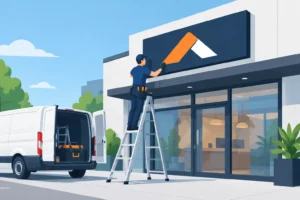
Even excellent signage can lose its impact through rushed setup. Confirm who is responsible for installation, what tools or fixtures are required, and whether signs need to be collected after the event. For large backdrops, external façade banners or multiple directional boards, professional installation support can protect both the materials and the venue.
Pack signage by zone where possible: registration materials together, stage materials together, and retail or sampling materials together. Label boxes clearly. This gives event staff a practical setup sequence and prevents essential signs being left unopened until guests have already arrived.
Make every printed surface earn its place
The best event environments do not use signage simply because there is wall space available. Each piece should guide a decision, reinforce a message or create a memorable brand moment. A clear welcome board sets the tone. A well-designed backdrop encourages photographs. A concise product display gives sales teams a natural conversation starter.
When you plan signage around real visitor behaviour, choose materials for the venue and give production enough attention, printed displays become more than event decoration. They become quiet, capable brand ambassadors – working from the first arrival to the final photograph.