A product launch is days away, the event date is fixed, and the final artwork has just been approved. When you need to order express print materials, speed matters – but so does avoiding a costly reprint, an unsuitable paper choice or a delivery that arrives too late to be useful. The strongest express orders are not simply rushed through production. They are prepared clearly, checked carefully and matched to the right print method from the start.
For businesses, marketers and event teams, express printing is a practical way to keep momentum when plans change. It can cover everything from business cards and flyers to banners, stickers, packaging sleeves, menus and point-of-sale displays. The key is knowing which decisions must be made before production begins and where flexibility can protect your deadline.
Start with the deadline, not the product
The most useful question is not, “How quickly can this be printed?” It is, “When must it be in my hands, ready to use?” Work backwards from the date your materials are needed. Include time for delivery, installation, packing, distribution and a final check once the items arrive.
A banner required for a morning exhibition, for example, should not be treated as a delivery due on the same morning. If it needs a stand, a printed panel, installation support or transport to a venue, every stage needs room in the schedule. The same applies to retail campaigns: labels, shelf talkers and product packaging need to arrive before stock is displayed, not after.
When placing an urgent request, provide a clear required-by date and explain the purpose of the materials. A print partner can then advise whether a digital run, a stock alternative, a simpler finish or split delivery will help meet the deadline. This is far more effective than requesting the fastest possible turnaround without context.
Prepare artwork before you order express print materials
Artwork approval is often the point where an express job gains or loses a day. A file that looks correct on screen may still have low-resolution images, missing bleed, unexpected fonts or colours that need reviewing before it can be printed.
For most commercial print items, supply a print-ready PDF at the final size, with images at suitable resolution and bleed added where trimming is required. Keep critical text, logos and design details safely inside the trim area. For folded brochures, booklets and packaging, check panel sizes and dielines before finalising the design. A small measurement error can become very visible on the finished piece.
Keep colours realistic and consistent
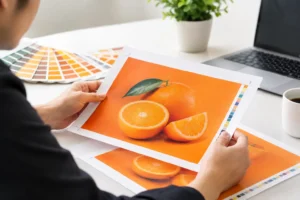
Screen colours are made from light, while printed colours are created with ink or toner on a physical surface. Bright shades can appear different once printed, particularly on uncoated stocks, coloured papers or textured packaging materials. If brand colour accuracy is essential, state this upfront and ask which process and stock best support your requirements.
A tight deadline may not allow time for extensive physical proofs. In that case, use approved brand colour values, supply the correct logo files and avoid last-minute colour changes after artwork sign-off. Consistency across your flyers, display panels, paper bags and promotional stickers will do more for brand recognition than an ambitious design rushed through without checks.
Make the final approval decisive
Assign one person to give final artwork approval. Multiple stakeholders can provide feedback before submission, but production should receive one confirmed file and one set of instructions. Conflicting revisions sent by email or messaging apps create unnecessary risk, especially when every production hour counts.
Name files clearly with the product, size, quantity and version number. For example, a file name that identifies the campaign, A5 flyer, 2,000 copies and final version is easier to track than a vague file labelled “new final revised”. Clear file handling protects both speed and accuracy.
Choose specifications that support your timing
Express printing does not mean every specification is available immediately. Some options require extra production stages, curing time, specialist machinery or manual finishing. That does not make them unsuitable, but it does mean your choice should reflect the real deadline.
Digital printing is often a strong option for short runs, variable data and fast-turnaround marketing materials. It suits business cards, flyers, menus, brochures, stickers and smaller promotional quantities where quality and speed need to work together. Offset printing can be more economical for larger quantities and offers excellent consistency, but it may require a longer lead time depending on the job.
Finishes such as foil stamping, embossing, Spot UV, die cutting and custom shapes create a memorable premium effect. They can be worthwhile for invitation cards, folders, luxury packaging or a high-value launch. However, if your event is imminent, consider whether a well-designed standard finish on a quality stock will serve the campaign better than a premium treatment that puts the schedule under pressure.
The same principle applies to materials. A specific imported paper or unusual board may be perfect for a flagship piece, while an available stock with a similar weight, texture and colour may be the smarter choice for an urgent order. The goal is not to compromise your brand. It is to make a considered trade-off that delivers a polished result on time.
Give complete production details at the outset
A complete brief allows your printer to identify the best route to production quickly. It should include the finished size, quantity, single- or double-sided printing, stock preference, finishing requirements, artwork status, delivery address and required date. If the materials are for an event or installation, include venue access details and any delivery restrictions.
For complex campaigns, it helps to group items by priority. You may need 500 brochures and 20 pull-up banners by Tuesday, while an additional 2,000 promotional postcards can arrive later in the week. A phased approach can keep your launch moving without forcing every item into the same urgent production window.
When you have several products to source, one supplier can also reduce coordination. Business stationery, campaign collateral, signage, packaging and branded giveaways often need to look like they belong to the same brand family. Ordering through a one-stop production partner makes it easier to align paper stocks, logo placement, colours and finishing choices across the full set.
Check the details that cause the most delays
Before approving an express print job, take five minutes to confirm the practical points that are easiest to overlook:
- The artwork dimensions match the ordered finished size.
- Bleed, safe margins and fold positions have been checked.
- Quantity, sides, stock and finishing instructions are stated clearly.
- The delivery contact can receive the order when it arrives.
- Any venue, security or loading-bay requirements have been shared.
- Final approval has been given by the person authorised to sign off.
This short review is not bureaucracy. It is a safeguard against discovering that a banner will not fit its display stand, a folded leaflet has text across the crease or cartons cannot be accepted at the event venue.
Plan delivery as part of the print order
For time-sensitive work, production completion and delivery are one connected service. Confirm whether delivery is included in the turnaround, whether collection is possible, and who will be available to receive the goods. Singapore offices, retail locations and event venues can have restricted delivery windows, visitor registration and loading procedures that must be arranged in advance.
Consider the format of the finished materials, too. Large-format displays, mounted boards and bulk cartons may require more space than a small parcel of business cards. If materials are being sent to several branches or event locations, ask whether they can be packed, labelled or delivered in separate batches. This can save your team valuable sorting time later.
Use express print for the moments that matter
Not every item needs an urgent turnaround. Routine replenishment is usually more cost-effective when planned in advance, particularly for high-volume catalogues, forms, packaging and recurring promotional materials. Express production is most valuable when it protects a genuine commercial opportunity: a last-minute event, an unexpected product launch, a new retail opening or a campaign change that cannot wait.
At 2B Printing, the aim is to make those urgent moments more manageable with practical advice, broad customisation and quality-focused production. Share your deadline, send your best available artwork and be open about what matters most – speed, finish, budget or brand impact. With the right decisions made early, your printed materials can arrive ready to make a lasting impression when the moment calls for it.