A busy exhibition hall gives visitors seconds to decide where to stop. Your custom exhibition display stands need to communicate who you are, what you offer and why it matters before a conversation even begins. For Singapore businesses exhibiting at trade shows, retail activations, conferences or community events, the right display is not simply a printed backdrop. It is a practical sales tool that gives your brand a confident physical presence.
The strongest stands do not try to say everything. They make one clear promise, use visual hierarchy to guide the eye, and give your team a space that feels organised and ready for business. Getting there starts with choosing a display system around the event, audience and objective – not just the available floor area.
Start with the job your stand needs to do
A product launch, recruitment fair and industry exhibition may all use display stands, but they ask very different things of the space. At a launch, your aim may be to create a memorable reveal and encourage photography. At a trade event, you may need a setting that supports product demonstrations and lead collection. For a corporate roadshow, quick set-up, compact storage and repeated use could matter most.
Clarifying the primary job prevents expensive compromises later. If the stand needs to be seen across an aisle, height, bold colour blocks and large-format messaging deserve priority. If visitors need to compare products, the layout should accommodate readable panels, samples and a counter where conversations can happen comfortably.
Think about what success looks like in measurable terms. Is it footfall, qualified leads, samples given out, sales appointments or social content? A display that is visually impressive but leaves no place for staff to speak with visitors may not serve a lead-generation campaign. Equally, a functional booth with no distinctive visual cue can disappear beside more polished competitors.
Choose custom exhibition display stands for the venue
The ideal format depends on your allocated footprint, venue rules, exhibition duration and how often you expect to reuse the system. A one-day mall activation has different demands from a three-day trade exhibition at a convention venue.
Portable systems for flexible campaigns
Pop-up displays, pull-up banners and lightweight fabric backdrops are popular for good reason. They are quick to transport, can be assembled by a small team and work well for businesses attending several events throughout the year. A coordinated set can include a backdrop, banner stands, a branded counter and promotional print such as brochures or stickers.
Their trade-off is scale and structural impact. Portable systems are excellent for standard booth spaces and temporary activations, but they may not create the architectural presence required for a major launch or large island booth. The answer is often not to abandon portability, but to layer it thoughtfully with counters, signage, floor graphics or product displays.
Modular displays for room to grow
Modular exhibition systems allow components to be combined into walls, corners, meeting areas and storage zones. They suit brands that attend recurring events but need to adapt to different booth sizes. Replaceable graphic panels also make it easier to refresh a campaign without replacing the entire structure.
This flexibility takes more planning. Measurements, access points, electrical requirements and sightlines need to be considered well before production. A well-designed modular stand can be used repeatedly, making it a sensible investment when event activity is frequent and brand consistency is a priority.
Bespoke builds for high-impact moments
Custom-built stands offer the greatest freedom in shape, materials, lighting and visitor flow. They can include shelving, reception counters, demonstration areas, illuminated logos and integrated digital elements. For a brand making a major market statement, these details turn a small plot into an experience people remember.
Bespoke does not automatically mean better. It involves higher production, logistics and installation requirements, and it only pays off when the event opportunity and campaign lifespan justify the investment. A compact booth with exceptional graphics and a well-trained team can outperform an oversized build with a confused message.
Make the message readable at a glance
Exhibition graphics should work from a distance first, then reward visitors who come closer. A common mistake is treating a backdrop like a brochure: multiple product descriptions, tiny logos and too much supporting text compete for attention. In a crowded hall, that information becomes visual noise.
Lead with one strong headline that reflects the visitor benefit. Then support it with a short statement, high-quality imagery and a clear next step. Your logo should be visible, but it does not need to occupy half the stand. The brand is also communicated through its colours, photography, tone of voice and the quality of every printed surface.
Typography matters more than many teams expect. Fine typefaces and light text can look elegant on screen but lose clarity under exhibition lighting or from several metres away. Use clear contrast, give text breathing room and test the artwork at the approximate size it will appear. If a message cannot be understood in a quick walk past, simplify it.
Where you have several product lines, create a hierarchy. The main campaign message belongs at the highest and most visible point. Supporting categories can sit on side panels, counters or takeaway materials. This approach keeps the space welcoming while allowing interested visitors to explore the detail in conversation.
Build a complete visitor experience
A display stand works best when the surrounding materials tell the same brand story. Branded tablecloths, reception counters, flags, posters, catalogues, name badges, product packaging and giveaway items should feel connected, not selected independently at the last minute.
For example, a food and beverage brand may pair a bold backdrop with sample trays, stand-up pouches, menu cards and printed vouchers. A service business might use a branded counter, a concise capabilities booklet and QR-enabled cards for quick follow-up. The stand attracts attention, while the supporting materials give visitors a reason to remember and contact you afterwards.
Consider the practical visitor journey as well. Can someone immediately see where to stand? Is there room for two conversations at once? Are product samples safe and easy to access? Is the lead capture point visible without becoming a barrier? These small operational details shape whether a beautiful space feels inviting or awkward.
Lighting deserves an early decision, especially in venues where ambient light is uneven. Spotlights can make key graphics and products more visible, while illuminated elements can add impact. However, lighting should support the message rather than compensate for weak artwork. It also needs to comply with venue power and safety requirements.
Plan production early enough to protect quality
The fastest way to create problems is to finalise a stand design without checking print specifications, installation requirements and delivery timing. Exhibition materials are often large, and small artwork issues become obvious when enlarged. Low-resolution images, missing bleed, unsuitable colours and poorly placed text can all affect the final result.
Work backwards from the event opening date. Allow time for artwork review, printing, finishing, fabrication, delivery and any site installation. Build in a buffer for venue approvals and revisions, particularly if the booth includes structures, electrical connections or hanging signage. Express turnaround can be valuable for urgent campaigns, but early planning gives you more material, finishing and design choices.
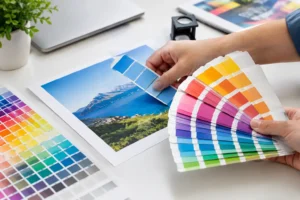
Request practical guidance on dimensions, substrates and finishing before committing artwork. Matte surfaces can reduce glare under bright lights, while gloss may make product imagery appear more vibrant. Fabric graphics can be lightweight and reusable; rigid boards can create crisp, stable signage; vinyl can suit selected applications. The best choice depends on the use case, expected lifespan and display environment.
A one-stop production partner can make this stage much easier. 2B Printing can coordinate display graphics alongside brochures, banners, point-of-sale materials, packaging and branded event essentials, helping teams maintain colour consistency and reduce fragmented vendor management.
Make reuse part of the brief
Sustainability and cost control often point in the same direction: design for reuse. Avoid printing event dates, venue names or short-lived offers across the main structural graphics unless the campaign truly requires it. Keep evergreen brand messages on backdrops and place changeable promotion details on replaceable panels, posters or banners.
Store stands in labelled protective cases, retain assembly instructions and photograph the completed layout for the next event team. Before reusing, inspect frames, connectors, fabric tension and graphic surfaces. A display that arrives clean, complete and easy to assemble protects your brand as much as the original print quality does.
The best exhibition stand is not necessarily the largest or most elaborate. It is the one that makes your brand recognisable, gives visitors a clear reason to engage and helps your team do their best work on the floor. Start with that purpose, then let the format, materials and finishing bring your vision to life.