A last-minute product launch, a pop-up event, a new menu, a revised price list – these are the moments when digital printing earns its place in your marketing toolkit. It gives businesses the speed to react, the flexibility to personalise and the quality to present every customer-facing detail with confidence.
For Singapore businesses managing busy campaigns and tight timelines, print is rarely just print. A business card starts a conversation. Packaging sets expectations before a product is opened. A banner has seconds to catch attention in a crowded venue. The right production method helps each item do its job without forcing you to order more than you need.
What digital printing does differently
Digital printing transfers artwork directly from a digital file to the chosen material. Unlike traditional offset printing, it does not require printing plates. That change has a practical impact: jobs can move from approved artwork to production quickly, making digital a strong choice for short runs, variable information and urgent promotional requirements.
It is particularly useful when your materials need to change often. A retailer may update point-of-sale messages for a seasonal promotion. A food and beverage business may test several packaging designs or print labels with different flavours. An events team may need name cards, programme booklets and directional signage with changing details. Digital production keeps these requirements manageable without the set-up costs associated with plates.
That does not mean digital is automatically the best choice for every project. Offset printing can offer better economies for very high quantities and is often preferred where exact colour matching across large-volume runs is critical. The practical question is not which method is universally superior. It is which one suits your quantity, deadline, material, budget and intended use.
When digital printing is the smart commercial choice
Digital print is built for agility. If you need 50 premium business cards for a new sales team, 200 flyers for a weekend activation or a limited batch of product inserts before stock ships, it can be a sensible route. You avoid ordering thousands simply to make production costs work.
Variable data is another major advantage. Instead of one generic direct-mail piece, you can print names, branch details, voucher codes or tailored offers across the same campaign. The core design remains consistent, while the message becomes more relevant to the person receiving it. For corporate teams, this can also simplify certificates, training materials, personalised invitations and event badges.
Digital production supports a wide range of everyday commercial materials, including brochures, catalogues, booklets, folders, stickers, labels, posters, menus, presentation packs and short-run packaging. The format matters, but the outcome matters more: clearer communication, stronger shelf presence, smoother operations or a more polished customer experience.
Speed should still be planned carefully. Express turnaround can help when deadlines move, but excellent print begins with production-ready artwork and clear specifications. Allowing time for proofs, finishing and delivery gives you more choices and reduces the risk of avoidable compromise.
Choosing materials that support your message
A sharp design can lose impact on the wrong stock. Paper weight, texture, coating and format all influence how customers read your brand. A lightweight flyer may be exactly right for a mass handout, while a premium uncoated card can make a consultancy or boutique retailer feel more considered and tactile.
For brochures and catalogues, think about how the piece will be handled. Will it sit on a counter, travel in a tote bag or be posted to prospects? A heavier cover can protect the pages and give the document authority, while the inner pages need to balance readability with overall cost. For menus and price lists, durability and easy cleaning may matter more than a luxurious feel.
Packaging requires a different set of decisions. It must protect the product, meet practical handling needs and communicate your brand quickly. A stand-up pouch, paper bag or retail box should carry colours, text and finishing that remain clear at the point of purchase. Before production, check dimensions, folds, bleed areas, barcode placement and any regulatory information required for your product category.
Signage and display materials need to be selected for their environment. Indoor counter displays, window graphics, event backdrops and outdoor banners all face different demands. Lighting, viewing distance, installation method and weather exposure can change the best choice of substrate and finish. A good print partner will ask where the item will be used, not only what size you want.
Finishing turns a printed item into a brand asset
Finishing is where functional print can gain a more memorable presence. Lamination adds protection and can create a matt or gloss appearance. Spot UV introduces contrast by highlighting a logo, pattern or headline with a glossy raised effect. Foil, embossing and hot stamping bring a premium touch to invitations, folders, gift packaging and selected corporate stationery.
These details work best when used with purpose. Too many special effects can make a design feel crowded, and they can add cost or time to a project. A single foil logo on a restrained business card may speak more confidently than a design competing for attention on every surface. Consider what the recipient should notice first, then choose finishing that reinforces that message.
Preparing artwork for reliable results
The fastest route to a successful print job is an artwork file that has been checked before it reaches production. Supply files at the final print size, include the required bleed and keep essential text away from trim lines. Bleed is the extra image area beyond the final cut edge, helping prevent unwanted white borders after trimming.
Use high-resolution images, particularly for photographs, product shots and large-format graphics. A picture that looks clear on a phone or laptop may become soft when enlarged for print. For logos and icons, vector artwork is usually the strongest option because it can scale cleanly without losing definition.
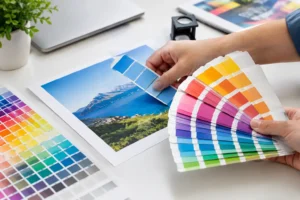
Colour deserves attention too. Screens use light, while print uses inks or toner on a physical surface, so colours can appear different. Designing in CMYK where appropriate and using recognised colour references for brand-critical work can help manage expectations. If your campaign relies on a very particular shade, ask about a proof or sample before committing to a larger run.
Finally, proofread with fresh eyes. Check telephone numbers, web addresses, dates, prices, QR codes, legal wording and product variants. A beautifully printed flyer with an incorrect event time is still an expensive mistake. For complex jobs, having a second person review the artwork is a simple but valuable safeguard.
Build consistency across every customer touchpoint
Many businesses treat cards, packaging, signage and event items as separate purchases. Customers do not experience them that way. They notice the same logo on a paper bag, a counter display, a staff uniform and a thank-you card, and those repeated signals shape their impression of your business.
A coordinated approach improves brand recognition and makes ordering easier. Set a clear colour palette, type hierarchy and logo-use guide, then apply them across your essential materials. Your campaign flyer can echo your packaging. Your exhibition booth can match your sales brochure. Your certificates and awards can carry the same level of care as your storefront signage.
This is where a one-stop production partner can save time. Rather than explaining your brand to several suppliers and trying to align different schedules, you can coordinate everyday print, campaign assets, packaging, display systems and customised merchandise through one workflow. The benefit is not simply convenience. It is greater control over consistency, costs and deadlines.
Getting the best value from a print order
Value is not only about the lowest unit price. Consider how long an item will remain useful, how many you can realistically distribute and what a weak first impression could cost. A short run of current brochures can be more valuable than a large run that becomes outdated after one pricing change.
Be clear about your priorities from the start. If speed is essential, say so. If a specific paper feel or finish defines the project, identify it early. If you are unsure whether to choose digital or offset, share the intended quantity and deadline. The right recommendation should be based on your actual requirements, not a one-size-fits-all answer.
At 2B Printing, the aim is to make those choices straightforward, with practical artwork guidance and production options that help your brand look ready for the next conversation, campaign or customer encounter. Start with the result you want people to remember, then let the format, material and finish bring that vision to life.