A customer notices your offer while walking past a shop, opening a delivered menu or leaving an event. They have only seconds to decide whether it is worth keeping. Effective flyer coupon printing gives that decision a clear answer: this is the offer, this is when to use it, and this is why you should act now.
For Singapore businesses, coupons can do far more than fill a quiet weekday. A well-planned printed offer can introduce a new menu item, bring first-time customers through the door, encourage a second purchase or support a launch in a particular neighbourhood. The difference lies in treating the flyer as a measurable sales tool rather than a sheet of promotional information.
Flyer Coupon Printing Begins With a Worthwhile Offer
The strongest coupon is not always the largest discount. A deep price reduction may attract attention, but it can also reduce margins and train regular customers to wait for the next deal. The right offer depends on what you need the campaign to achieve.
A café looking to build a lunchtime crowd may offer a complimentary drink with a main meal during quieter hours. A beauty business may give a value-added upgrade on a first appointment. A retailer introducing a new range might offer a fixed dollar saving above a minimum spend. These offers protect the perceived value of your product while giving customers a practical reason to visit.
Make the action simple. A customer should be able to understand the benefit without turning the flyer over several times or studying fine print. State the saving or reward prominently, specify the redemption period, and make any minimum spend or exclusions clear. If the offer feels complicated, people are less likely to keep it and your front-line team may face avoidable questions at the counter.
A good rule is to build one primary message around one desired action. Trying to promote a new location, five product categories, a loyalty programme and three discounts on one small flyer weakens every message. Choose the campaign priority, then let the coupon support it.
Design a Coupon People Will Keep
A coupon flyer needs both visual appeal and immediate clarity. Your logo, colours and typography should make the piece recognisably yours, but the offer must still lead the page. Use a clear hierarchy: first the saving or reward, then the product or service, followed by the expiry date and redemption instructions.
High-quality product photography can work particularly well for food, retail and beauty brands. For service-led businesses, a clean layout with a confident headline and a strong brand image is often more persuasive than a crowded collage. Leave sufficient white space around the main offer. Space is not wasted when it helps the customer see what matters first.
The reverse side is valuable real estate. Use it to add a location map, operating hours, a short menu highlight, booking details or terms and conditions. If customers need to present the coupon physically, add a clear cut line or a design that makes the voucher section easy to recognise. A detachable coupon can feel more purposeful, while a full-flyer coupon is often more economical for large-volume distribution. The best choice depends on the campaign budget and how the flyer will be handed out.
Avoid making the redemption process depend on tiny text. Terms must be legible at normal reading distance, especially expiry dates, minimum spend conditions and any statement such as one coupon per transaction. Clear communication protects customer trust as much as it protects your business.
Add a Code That Lets You Learn
Printed coupons become more valuable when you can identify where responses came from. Use a unique code for each distribution area, partner outlet, event or campaign variation. A code such as ORCHARD10 or EASTSIDE15 allows your team to record redemption patterns without adding friction for customers.
You can also print a QR code that leads to a booking page, menu, sign-up form or campaign landing page. It should support the offer, not replace essential information. Some customers will scan it immediately; others will retain the printed coupon and redeem it in person. Include the key details on the flyer either way.
For campaigns with several outlets, codes can help reveal whether direct handouts, counter displays or mailbox distribution are producing the strongest results. That insight makes the next print run more targeted and cost-effective.
Choose the Format and Paper for the Job
Size affects both visibility and distribution cost. A6 flyers are compact, easy to carry and suitable for counter displays, inserts and handouts. DL flyers work well for menus, service offers and letterbox drops because their slim shape holds information neatly. A5 gives more room for striking images, detailed promotions or multiple product highlights.
Paper choice shapes how customers perceive the offer. A lighter stock may be practical for high-volume campaigns where reach is the priority. A sturdier stock feels more substantial and is more likely to survive in a wallet, handbag or car until the customer is ready to use it. For premium retail, hospitality or corporate promotions, thicker art card can reinforce the quality of the brand behind the coupon.
Finish matters too. Gloss lamination can make food imagery and bold colours stand out, while a matte finish offers a refined, contemporary feel and is easier to write on if staff need to stamp, date or personalise the voucher. If you need a coupon to be torn off cleanly, perforation is a practical finishing option worth considering during planning rather than after the artwork is approved.
Special finishes such as Spot UV, foil or embossing can create an impressive tactile effect for invitation-led offers or premium launches. They are not necessary for every campaign. For a short, time-sensitive discount, sharp design, quality colour reproduction and a clear call to action will usually deliver more value than elaborate finishing.
Prepare Artwork That Prints Cleanly
A compelling screen design is not automatically print-ready. Images should be high resolution, text needs safe margins, and artwork should include bleed so colour or photographs extend neatly to the edge after trimming. Small mistakes can become very visible across thousands of copies.
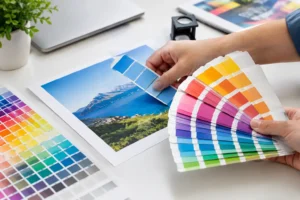
Use CMYK colour settings for print artwork rather than relying on RGB colours intended for screens. Bright digital hues can shift when converted, particularly certain blues, greens and fluorescent tones. If an exact brand colour is central to the campaign, discuss the requirement before production so the most appropriate print method and stock can be selected.
Before approving the final file, check four details carefully:
- The offer, code and expiry date are correct.
- Contact details and outlet information are current.
- Terms are readable and match staff instructions.
- QR codes scan successfully from a printed-size proof.
This short review prevents the most expensive kind of error: a professionally printed campaign that cannot be redeemed as intended. First-time buyers do not need to navigate these technical details alone. Artwork guidance can help turn a strong idea into a finished piece that prints as expected.
Match Distribution to Customer Behaviour
The best-designed coupon will not perform if it reaches the wrong people at the wrong moment. Think about where the offer makes the most sense. A gym trial coupon may work near offices or residential developments. A family dining offer may perform better through nearby schools, community events or partner businesses. A retail launch can benefit from handouts near complementary shops where shoppers are already in a buying mindset.
Timing is equally important. Print and distribute with enough lead time for customers to notice the offer, but avoid such a long redemption window that urgency disappears. Weekday-specific offers can shift demand into quieter periods. Weekend offers can create buzz, although they may add pressure where capacity is already tight.
Train staff before the flyers go out. They should know the offer terms, how to process each code, and whether coupons can be combined with other promotions. A smooth redemption experience matters because the printed flyer may be a customer’s first physical interaction with your brand.
Plan the Next Print Run From Real Results
Set a realistic objective before ordering. You might measure redemptions, average transaction value, new customer sign-ups, bookings or repeat visits within a defined period. Redemption rate alone can be misleading: a smaller campaign that brings in high-value customers may outperform a wider discount with many low-margin transactions.
Keep a record of how many flyers were printed, where they were distributed and which codes were used. This gives you a practical basis for changing one variable at a time in the next campaign, whether that is the offer, design, location, format or quantity. Consistent testing is how flyer marketing becomes more predictable.
At 2B Printing, businesses can coordinate coupon flyers alongside menus, posters, counter displays, packaging and event materials through one production partner. When every touchpoint carries the same campaign look, the offer feels more credible and your brand is easier to remember.
A coupon should never feel like a desperate price cut. Give customers a timely reason to try you, make redemption effortless, and place a professionally printed reminder in their hands. That is how a modest flyer earns its place in a much bigger customer journey.