A new lunch set, a weekend opening offer or a limited-time service package can disappear quickly in a crowded feed. A well-made flyer puts the message directly into a customer’s hands, where they can read it, keep it and act on it. For flyer printing for small businesses, the strongest results come from treating each piece as a focused sales tool, not simply a smaller poster.
For Singapore businesses competing for attention in neighbourhoods, offices, retail spaces and events, flyers remain a practical way to create local visibility. They are quick to produce, easy to distribute and flexible enough to support anything from a store launch to a referral campaign. The key is matching the format, design and quantity to one clear business objective.
Start with one action, not every message
A flyer has limited space and limited reading time. Before deciding on paper or finishes, decide what you want the recipient to do. That may be visit a newly opened outlet, scan a QR code for a voucher, book an appointment, try a menu item or attend an event.
Trying to introduce your entire company, list every service and promote three separate offers on one sheet usually weakens the result. A dental clinic, for example, may use one flyer for a first consultation offer, while a second piece explains its family care services. A café might promote a weekday lunch deal rather than reproducing its full menu.
Put the offer or benefit where it can be understood at a glance. Use a clear headline, supporting details and one obvious call to action. If there is a deadline, state it plainly. If customers need to present the flyer in store, make the redemption terms readable without letting small print take over the design.
Choose the flyer format for the job
Size affects both cost and usefulness. A6 flyers are compact, economical and well suited to vouchers, event reminders and handouts at busy locations. A5 is a popular choice when you need room for stronger imagery, a menu highlight or several short service benefits. DL flyers have a more refined, vertical format that works well for price lists, invitations and direct mail. A4 can be effective for detailed promotions, property listings or notices, but it may be excessive for a simple takeaway offer.
Single-sided printing is appropriate when the message is short and the budget is tight. Double-sided printing gives you more room to separate the attention-grabbing offer from practical information such as opening hours, location, contacts and terms. It is often a worthwhile upgrade when a busy front design would otherwise feel crowded.
The right paper stock also depends on what the flyer needs to communicate. A lightweight stock keeps large-volume campaigns cost-effective, especially for door-to-door distribution. A thicker stock feels more substantial for premium services, corporate introductions or retail counter displays. Gloss art paper makes food, products and bright photography appear more vivid, while a matt finish offers a smooth, understated look that suits professional services and text-led designs.
There is no universal best choice. A value-led neighbourhood campaign may need maximum reach at a controlled unit cost. A boutique brand inviting customers to an exclusive launch may benefit more from a heavier card and refined finishing. Good flyer printing for small businesses balances the impression you want to make with the likely lifespan of the piece.
Design for a three-second decision
Most flyers are judged before they are properly read. Your brand colours, logo and offer should establish who you are and why the recipient should care within seconds. This does not mean filling every space with large type and bright graphics. It means creating a clear visual order.
Lead with one strong image, product shot or headline. Give it room to breathe. Use typefaces that stay legible at print size, especially for prices, URLs, contact details and redemption conditions. High-resolution images are essential: a photograph that looks acceptable on a phone can look soft or pixelated when enlarged for print.
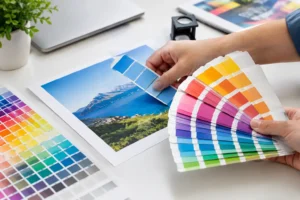
Colour must be considered for print, not only on screen. Monitors display colour with light, while commercial printing uses ink, so the finished shade may differ slightly from a digital preview. Supplying artwork in CMYK and checking proofs carefully helps avoid unwelcome surprises. A rich black background, for instance, may need a suitable CMYK build to look deep and even in print.
QR codes can connect a physical flyer to an online menu, booking page, catalogue or promotional landing page. Keep the code large enough to scan easily, leave clear space around it and test it from a printed proof before production. Add a short instruction beside it, such as ‘Scan to claim your welcome offer’, so customers understand the value of scanning.
Prepare artwork with printing in mind
Artwork should include bleed, typically 3 mm beyond the finished edge, where background colours or images run to the trim line. Keep text, logos and essential details safely inside the trim area. This prevents important content from being cut too close to the edge during finishing.
For first-time buyers, professional artwork guidance can save both time and reprint costs. A print partner can flag low-resolution images, missing bleed, unsuitable file settings or fonts that have not been embedded before the job goes to press. That small check is particularly valuable when the campaign has a fixed launch date.
Plan distribution before you place the order
A pile of attractive flyers in the office is not a campaign. Distribution should be planned at the same time as design and printing, because it determines the quantity, format and offer.
Think about where the target customer already spends time. A fitness studio might distribute near offices before and after work. A tuition centre may focus on family-oriented retail areas and community noticeboards. A food and beverage business can place a voucher at nearby residential blocks, partner counters or relevant local events, subject to venue and distribution permissions.
Hand-to-hand distribution gives staff the opportunity to explain an offer and answer a quick question. Counter displays work for customers who are already engaged with your business. Inserts in takeaway orders can encourage a second visit, while direct distribution supports geographic targeting. Each route has different costs and response rates, so avoid choosing based on quantity alone.
Timing matters just as much. Print a festive promotion early enough for distribution and repeat visibility, not the day before the offer begins. For a short campaign, a smaller first run can be sensible. You can assess response, refine the message and reorder with greater confidence rather than committing the full budget to an untested design.
Make the offer easy to measure
Flyers are more accountable than many businesses assume. Use a campaign-specific QR code, voucher code, phone extension or offer phrase to identify where enquiries and sales come from. For a physical redemption, ask staff to collect the flyer or record the code at checkout.
Track more than the number printed. Compare redemptions with distribution volume, then consider the value of each sale and whether customers returned later. A 2,000-piece run that brings in regular customers may be more valuable than 10,000 flyers that generate only one-off discount hunters.
Keep a simple record of the design, offer, location, date and quantity for every campaign. Over time, patterns become clear. You may find that A5 double-sided flyers work best for corporate services, while A6 vouchers perform better around a particular retail location. This is how print becomes a repeatable marketing channel rather than a one-time expense.
Use flyers as part of a joined-up brand presence
A flyer is more convincing when it looks and feels connected to the rest of the customer experience. The same colours, message and visual style can carry across business cards, stickers, menus, packaging, banners and point-of-sale displays. When customers encounter the brand again, recognition is immediate.
This is particularly useful for new product launches, pop-up activations and seasonal promotions. A flyer can invite people to a booth, while matching signage attracts them on arrival and branded packaging keeps the experience visible after purchase. Sourcing these materials from one production partner can also simplify colour matching, timelines and artwork management.
At 2B Printing, businesses can combine everyday promotional flyers with the wider materials that make a campaign feel complete, from display pieces to packaging and event print. The aim is not to add print for its own sake, but to give every customer touchpoint a clear role.
A flyer earns its place when it gives the right person a useful reason to respond. Start with a focused offer, print it in a format that suits its purpose, and put it where your customers are already looking. A simple piece of paper, thoughtfully planned, can become the first step towards a lasting customer relationship.