A quotation accepted by a new client, a handwritten thank-you note tucked into an order, a letter sent to a landlord or supplier – these are small moments where your business is judged before anyone reads the full message. Branded stationery printing gives those everyday interactions the polish, consistency and credibility that a growing brand needs.
For Singapore businesses, stationery is rarely just stationery. It supports sales conversations, keeps internal processes organised, reinforces your identity at events and makes even routine correspondence feel considered. The strongest results come from treating every piece as part of one connected brand system, rather than ordering business cards, letterheads and folders as separate afterthoughts.
Why branded stationery printing still matters
Digital communication is fast, but physical materials have a different kind of presence. A well-made letterhead on quality stock makes a formal proposal feel more established. A presentation folder keeps a sales kit orderly and gives the recipient something tangible to keep. A branded notepad at a meeting quietly places your business in view long after the meeting ends.
This is especially useful when trust needs to be built quickly. Professional services, property businesses, retail brands, F&B operators and corporate teams all rely on details that signal care. Consistent typefaces, colours, logo placement and paper choices tell customers that the same care goes into your products or services.
Stationery also has a practical job. Forms need to be easy to complete. Envelopes must protect what is inside and carry the correct return details. Name cards should be legible at a glance. Good design is not decoration added at the end – it helps people act on the information you give them.
Build a stationery set around real business moments
Start with where your brand physically meets customers, partners and staff. A lean start-up may need name cards, letterheads and envelopes first. A sales-led business may gain more from folders, proposal covers, notepads and quotation forms. A retail or hospitality brand might add loyalty cards, vouchers, gift certificates and branded writing pads for day-to-day operations.
The aim is not to print every possible item. It is to create a set that works together and earns its place. Ask what your team sends, hands over, signs, displays or packs most often. Those are the formats that deserve attention first.
The essentials that carry your identity
Name cards remain valuable in face-to-face Singapore business settings, particularly at trade shows, client visits and networking sessions. Keep the front clear enough for a name, role and contact details to be read quickly. A QR code can be useful, but it should support the card rather than compete with the key information.
Letterheads and envelopes make formal correspondence recognisable from the moment it arrives. Use them for contracts, official notices, welcome letters and statements. Matching details across both formats – including address, website, registration information and logo treatment – prevents the brand from looking pieced together.
Presentation folders are an effective choice when documents need to travel together. They are useful for tender submissions, property packs, onboarding materials and corporate presentations. Consider whether you need a business-card slit, an internal pocket, or space for a customised insert before settling on the final size.
The pieces that make operations easier
Custom forms, invoice books, delivery orders and duplicate or triplicate NCR pads bring clarity to daily administration. They can include serial numbering, tear-off sections and fields designed around how your team actually works. This reduces handwritten workarounds and creates a more consistent customer experience.
Branded notepads and desk calendars can also be practical promotional tools. They work best when the design remains genuinely useful: ample writing space, clear dates and restrained branding. If the item is helpful enough to keep, your name stays visible without feeling intrusive.
Choose paper and finishing with purpose
Paper is one of the first things people notice, even when they cannot name the stock. It affects colour, texture, writing comfort and the overall impression of value. A bright smooth uncoated stock suits letterheads and forms because it accepts handwriting and stamps well. A coated stock can make photography and bold graphics look sharper on folders or promotional inserts.
Thickness matters too. A lightweight sheet is sensible for high-volume correspondence and keeps posting costs manageable. Heavier card stock gives name cards and covers a more substantial feel. The right choice depends on the role of the item, the quantity required and the way it will be handled.
Finishing should add a reason to pick up, keep or remember the piece. Foil stamping can give a premium accent to a logo. Embossing creates a tactile detail that works particularly well on minimalist designs. Spot UV adds contrast to selected areas, while die cutting can create a distinctive shape, window or tab.
These options are powerful when used selectively. Applying several finishes to every item may increase cost without improving clarity. For an everyday form or letterhead, simple, crisp printing is often the better investment. Reserve special finishes for customer-facing pieces where the impact justifies them, such as executive name cards, presentation folders or gift certificates.
Get the artwork right before production
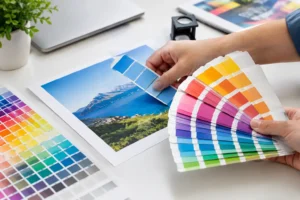
A polished print run starts with suitable artwork. Logos should be supplied in high-resolution or vector format so that lines and type stay sharp at every size. Images need enough resolution for print, not only for screen viewing. Colours should be prepared in CMYK where appropriate, as screen RGB colours can shift when reproduced on paper.
Set up artwork at the final finished size and include bleed where a background colour or image runs to the edge. This extra printed area is trimmed away and prevents unwanted white edges. Keep important text, logos and QR codes safely inside the trim area, especially on folded or die-cut formats.
Proofreading deserves more attention than it usually gets. Check telephone numbers, email addresses, legal details, job titles and web addresses against approved sources. Read the artwork at actual size if possible. Tiny type that looks acceptable on a large monitor can be difficult to read once printed.
If you are ordering several items at once, create a short brand reference before approving files. It should confirm logo versions, colour values, typefaces, layout rules and approved contact details. This makes repeat orders faster and helps different teams maintain the same standard.
Plan quantities, timing and budget sensibly
Ordering more can lower the unit price, but the lowest unit price is not always the lowest overall cost. Contact details, team structures, seasonal offers and legal wording can change. For materials that may be updated often, choose a quantity that balances value with flexibility. For stable, high-use items such as envelopes or standard forms, a larger run may make better commercial sense.
Allow time for design checks, proof approval, production and delivery, particularly before a launch, exhibition or major client presentation. Express turnaround can be invaluable for urgent requirements, but early planning gives you more choice over materials and finishing.
It also pays to group related requirements with one production partner. Matching stationery, folders, stickers, packaging, event materials and signage through one supplier makes colour management and brand consistency easier. It can reduce the administrative burden of coordinating several vendors, too.
At 2B Printing, businesses can combine everyday stationery with promotional and event print requirements, supported by artwork guidance and tailored finishing choices. That one-stop approach is helpful when a campaign needs more than a stack of name cards – it needs every physical touchpoint to look like it belongs to the same brand.
Make each printed piece worth keeping
The best stationery does not shout for attention. It makes the recipient feel that your business is prepared, clear and reliable. Keep information easy to find, let the design breathe and choose materials that suit the occasion rather than chasing luxury for its own sake.
When the next proposal, welcome pack or customer order leaves your hands, consider what it says before the first word is read. A thoughtful printed piece can carry your brand’s voice into that moment – and give people a reason to remember it.